
NOTES FROM BECOMING
When the right thing is no longer obvious.
We had been here for just a few hours and night was falling, fast. So was the rain.
The headlights turned every wet leaf silver. The old white house appeared in fragments behind the trees — a wall, a window, the edge of a roof — and then disappeared again into the blackness around it.
It was a good thing that fragile, irreplaceable items . . . anything too much a part of us to entrust to the big move — photographs, papers, those assorted pieces of life you carry yourself because they feel too important to hand over — had gone ahead of us.
Everything else arrived now — the ordinary things that seem to disappear into a house until you take the house away, suddenly lifted out of one life and carried through the rain towards another. And the ramshackle old farmhouse seemed very small beside it all.
Nobody stopped to mark the occasion. There was no moment when the three of us stood together with our wet hair plastered to our faces and clothing sticking to our skin, looked at the house and said, We’re here. There was simply a truck to unload before everything inside it became soaked.
So we carried.
And slowly the great white truck emptied.
The driver had come straight through the gate, stopped in front while we unloaded, and now continued around the back to leave the same way. No-one had thought any further than that.
The clay had.
It had been drinking in the water while we carried our life through the rain.
Beneath the grass, the earth had softened into slick, sticky mud. The tyres bit down, spun and sank. The wheels turned. The truck went nowhere.
With the tyres fighting for grip in mud that seemed determined to swallow them, Gus brought his beloved 4×4 Colt bakkie to the rescue. Armed with a tow rope, he pulled while the truck pushed, engines straining in the dark, men shouting over the rain, women huddled under umbrellas.
Mud churned beneath the tyres. Wet branches flashed in the headlights. The smell of churned earth and grass rose from the ground and mixed with diesel fumes hanging heavy in the damp air.
Eventually, slowly, the truck slid forward and found some traction.
And for a moment, it looked as though the debacle was finally over.
Another round of smiles, hugs and thanks followed the cheering, and the driver turned towards the gate and the gravel road beyond it.
The turn was tight.
Very tight, as it turned out — for an enormous old ostrich transport truck.
And then there was a tree.
Not a magnificent tree. Not one of the great old trees that had helped me fall in love with the property. It was not even particularly large.
It was simply solid.
Rooted.
Unwilling to move.
The truck had slid in the mud, turned too tightly and wedged itself against the small determined tree. There was no going forward and no going back without damaging the truck.
Umbrellas came out again. Everyone gathered around the problem, offering suggestions. The obvious solution surfaced almost immediately.
Cut the tree down.
I don’t remember thinking about it.
I remember the certainty.
No.
It was raining. Everyone was tired. An enormous truck was stuck inside the property with no obvious way of getting out. And still, somehow, cutting down a perfectly healthy tree because we had managed to wedge an enormous truck against it seemed completely unreasonable. We had come here because we wanted to live differently. Arriving and immediately beginning to rearrange the place around ourselves simply because a title deed now carried our names would have felt like a betrayal.
So instead of cutting down the tree, the men began cutting pieces off it. A branch. Then another. And another.
The truck seemed impossibly close to everything. The tree. The fence. The plants. People moved in and out of the headlights, wet shirts clinging to their backs, while the rain kept falling.
Eventually the truck nosed through the gate, straightened, found the gravel road and drove away into the dark. Behind it were churned tyre marks, broken branches, mud, wet people and one slightly butchered but very much still living tree.
In daylight, the farm felt as though it had been growing without supervision for decades and even the house seemed to have spent years being quietly absorbed by its garden. Plants grew against the walls and around corners. Creepers travelled over old plaster. Branches leaned over roofs. Great splashes of flowers emerged through masses of green, and magnificent sprays of red flowers spilled around the corner of the building that would eventually become the bakery.
Nothing appeared to have been arranged for effect. Everything simply grew.
I loved it before I understood it.
The rest of the property was so densely wooded that stepping into it felt like entering another world.
The harsh brightness of a summer day fractured high above us and came through the leaves in shifting patches, mottling the ground in greens and golds. The air cooled. There was shade and the soft, enclosed feeling of being under a roof. Underfoot were layers of leaves, bark, twigs and whatever the wind had brought down, soft beneath our feet. Somewhere above, birds called from branches hidden inside the canopy.
I knew almost nothing about any of it. Only how it felt to stand in it.
Sheltered.
Old.
Generous.
Safe.
Magical in a way only a long undisturbed woodland can be.
It felt, then, as though leaving things alone was one of the purest forms of care.
The trees became part of our daily life when the builders began taking the house apart, because fixing a roof, it turned out, involved making most of it disappear. Men moved along the skeleton of rafters against the sky. Rooms that had been indoors suddenly had daylight pouring into them from above. Timber, ladders, building rubble and tools spread out around what had been the garden. Everywhere there was hammering, sawing, shouting, dust and things temporarily put somewhere they did not belong. “Fixing” the house turned out to be a generous description.
But Grade One, apparently, continues whether your house has a roof or not. So in the mornings we collected schoolbooks, pencils and whatever we needed for the day’s lessons and walked away from the activity and noise to the far end of the ridge. Under a long row of enormous old blackwood trees, Angel would sit with her workbook open in front of her, pencil in hand, learning the small serious business of learning while Lillianna Pig, Jessie and RiffRaff explored and played around our feet.
Birds, insects and leaves flitted above and around us, and conventional schooling would lose its importance as small daily discoveries — that always seemed considerably more urgent than whatever waited on the page — were made.
Then the faint banging and sawing of the builders up at the house, carried along the ridge, would remind us . . . and the pencil would come down again, back to Grade One.
I would look up from the camping table and watch the light moving through those immense branches, almost overwhelmed by the fact that this had become our life. How absurdly lucky we were.
Our home dismantled.
Our lives in boxes.
Grade One at a camping table in a forest of trees we could not name.
Not picturesque.
Not tidy.
Not remotely under control.
Beautiful.
And I loved it.
Returning to the house after school was always fun. We played as we followed our track back towards the house for a communal lunch, excited to see what changes or progress had magically appeared during our absence.
Until one day that burns in my memory still.
The building that would become the bakery had been as entangled in the garden as the rest of the house. Plants grew right up against it. Things climbed and flowered everywhere, softening and hiding the old plaster and rough edges.
That day, we came back and everything growing around it was gone.
The leaves. The climbers. The flowers.
All the soft, unruly green had been replaced by exposed earth, rubble and an uninterrupted view of an old white wall.
Not trimmed back.
Not neatly dug away or removed for replanting.
Trampled. Demolished by heavy boots, repeated foot traffic, building materials and scaffolding.
Bare ground and mushed-in plants where abundance and beauty had been.
I was devastated.
I had not even learned their names yet, and now I could not name what had been lost. Nor replace what had been destroyed.
Yesterday it had been alive and beautiful. And now it wasn’t.
There were reasons, of course.
The builders needed access. The building would become Angel’s Kiss Home Bakes. There would be food prepared inside it, inspections, hygiene requirements, practicalities utterly indifferent to how lovely a flowering plant looked spilling over an outside wall.
Of course it had to be cleared.
It made perfect sense.
Something can make complete sense
and still feel awful.
As we settled in, we began learning what was actually growing around us.
Blackwood.
Wattle.
Alien.
Invasive.
I disliked the last two almost on principle.
Some of the blackwoods were so large that it was difficult to imagine how many years they had stood there. Their trunks were thick and deeply furrowed, too broad to put my arms around, their branches stretching high above us. Birds nested in them. They gave us shade. They gave us a classroom. They had become part of the life of the place.
Habitat. Shelter. Beauty.
And beneath them, other life was being crowded out. Once someone showed you where to look, you could see it. And wonder how you had missed it.
Dense stretches of wattle. Blackwoods taking the light. Indigenous growth surviving where gaps appeared, waiting beneath and between the trees.
Knowing this did not make the blackwoods less beautiful.
Calling one alien did not make it look less like a tree.
Whenever clearing was discussed, my eyes went to the giants.
Surely not that one. Definitely not those.
There seemed an obvious compromise.
Take the small trees.
Clear the wattles.
Leave the giants.
Be reasonable.
In those first months, almost everyone who came through our gate belonged to a world we had only just entered. They knew the valley — the roads, the weather, who had a tractor, who could fix something.
We were constantly asking. Constantly learning. Constantly discovering that something we had assumed would be straightforward was not.
Then the old man began coming. I wish I could remember his name. I remember almost everything else about him.
His white hair. His face. His kind eyes. The way he knew wood.
He could look at a trunk and see what was inside it. Timber. Firewood. Useful logs. What was worth taking. What would repay the effort required to bring it down and cut it up.
At first, his arrival was an event. Then he began coming regularly. His little white bakkie appeared through the gate again. And again. Until somewhere along the way he stopped feeling like somebody else’s life arriving on our farm. He was simply there because there was work to do.
I liked seeing him. I liked his gentleness. I liked the familiarity of another morning beginning with his little white bakkie coming through the gate.
He knew his work.
And he was kind.
There was comfort in that.
There was also an arrangement that seemed almost perfect.
We had installed a Dover stove that consumed an astonishing amount of wood just to cook supper.
The farm was full of alien trees that needed clearing.
The old man could cut them.
He could take what was useful.
We would be kept supplied with firewood.
The land would slowly open again.
Everyone gained something.
Nothing wasted.
No one losing.
A beautiful circle.
Until it became clear where his money lay.
Not in the wattles. Not in the scrub. Those made good firewood, but there was little value and a great deal of labour in them.
His livelihood stood in the trees I loved most. The giants. With trunks thick enough to produce valuable timber. The ones that made his work worthwhile. The ones I looked at and thought: Not that one.
The tree was beautiful.
The indigenous growth underneath it mattered.
The old man needed to earn.
We needed the wood.
It was all true.
It all mattered.
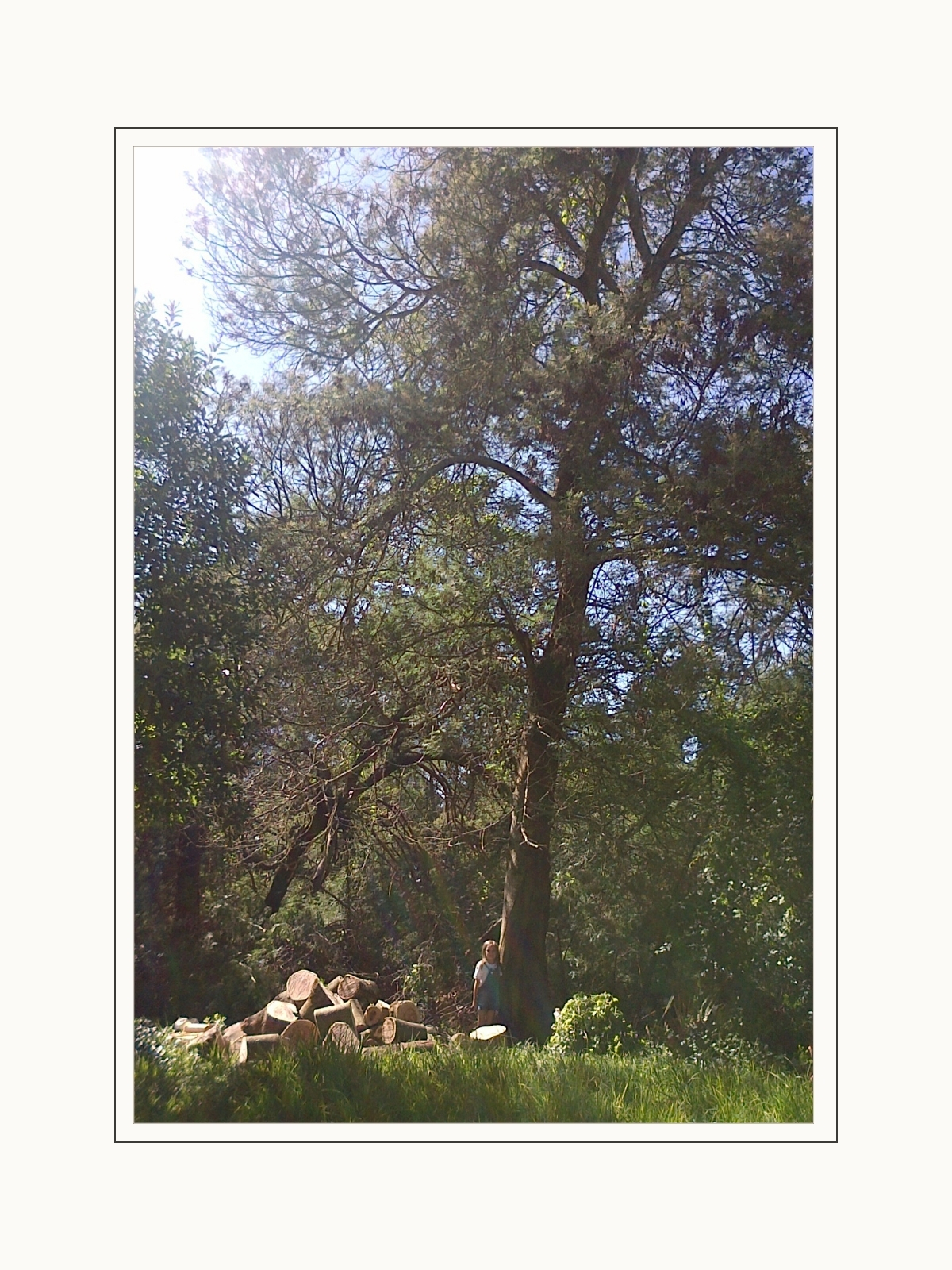
And yet, the day the first giant blackwood came down felt momentous. We planned ahead and made sure we were all there. Before anything began, I photographed Angel standing next to it.
As if that would somehow help preserve it.
Once the chainsaw started, it was shockingly quick. Professional. Practised.
There is a point when the sound changes. The chainsaw stops being the loudest thing. A groan comes from somewhere deep inside the tree. The first crack. And then, for a few strange seconds, everything seems to slow down.
The tree doesn’t fall.
Not yet.
It begins to splinter. To break apart somewhere deep inside itself. You almost hear the fibres straining before they split. Another crack, then another, as though each part is holding on for just a moment longer before finally giving way.
Seconds stretch. It feels as though you are suspended there with it, listening and waiting.
And then it goes.
The great crashing rush through the surrounding branches.
Then the thud.
Deep enough to come through the earth.
Deep enough to reverberate through your heart.
I bore witness because I felt I must. All I wanted to do was turn away.
Even fourteen years later, that unique sequence of sounds still stops me. A moment of respect for the tree and the life it has lived. The ache of another loss. A quiet hope — almost a prayer — that its falling is serving something larger than mere destruction. Then life carries on.
That day . . .
The work had gone well.
The tree had come down safely.
There was valuable timber.
There would be firewood.
The old man had work worth doing.
Light was reaching the ground.
My mind went to school.
Scale.
Measurement.
Numbers.
Perhaps count rings.
Before the tree came down, I had photographed Angel standing beside it, her smallness showing just how enormous it was. Now I made her climb up onto the stump. Barefoot and distinctly unimpressed, she stood there while I stepped backwards and took another photograph.
Angel on the stump.
The old man beside her with his white hair.
Gus.
Jessie.
The fallen tree still lying across the ground behind them.
Nothing in me had stopped loving it.
Nothing in me thought we should have kept it.
Both were true.
.